
Module 4 of 11
Type 2: ED emergencies and the sandwich technique
Recognise the emergency, summarise your priorities with the sandwich technique, then work through A–E, AMPLE and retrieval.
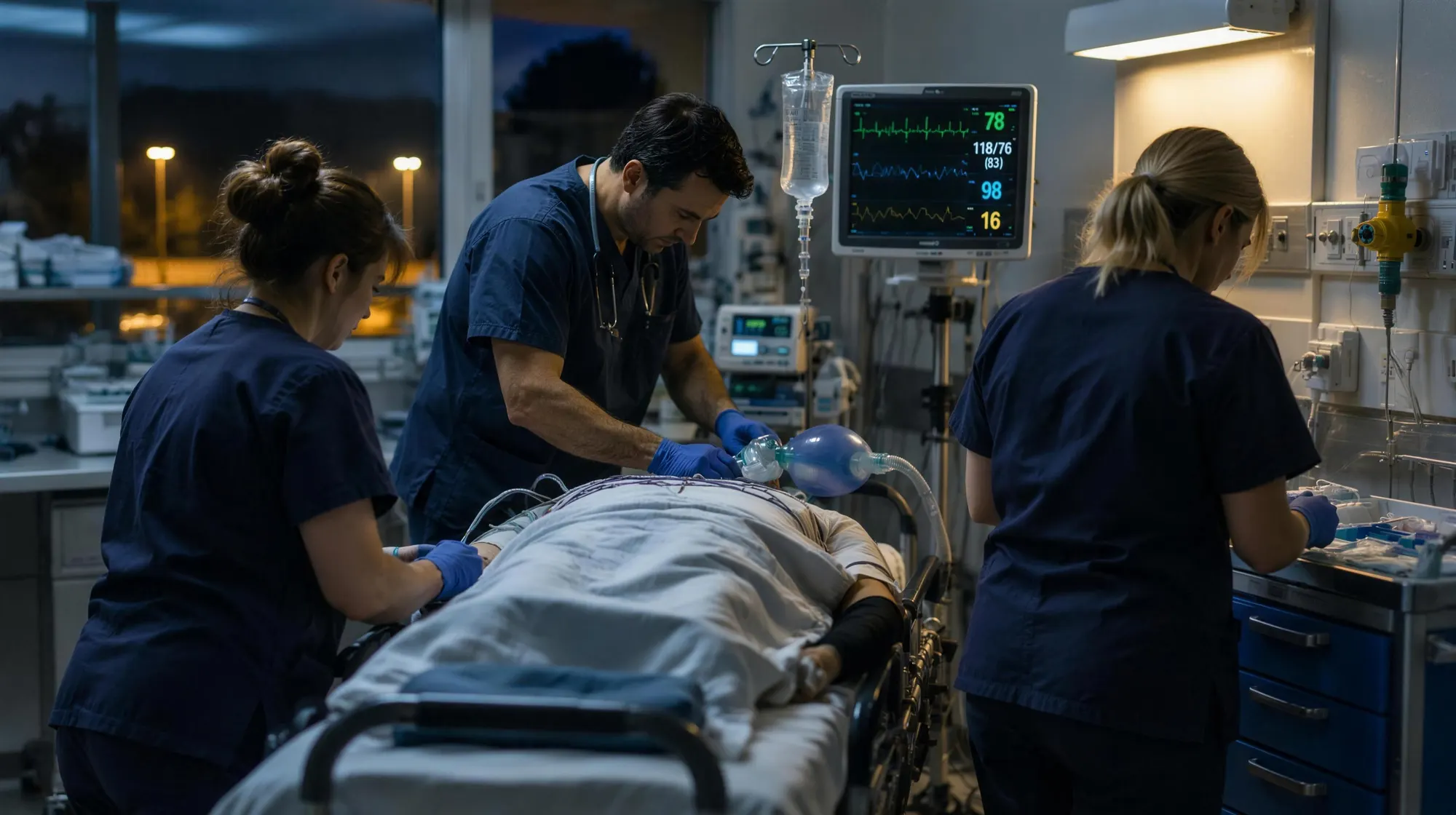
Emergency questions may involve an obvious diagnosis or an undifferentiated, critically unwell patient. In both situations, you need to recognise the urgency, prioritise treatment and demonstrate a structured approach.
A mentor taught me the sandwich technique, and I found it particularly useful. It helped me communicate my immediate priorities, include essential treatment and remember to involve retrieval early.
This is the structure that worked for me. Use it as a starting point and adapt it to your own speaking style.
Recognising a known emergency
Let’s begin with a case where the stem strongly suggests the diagnosis:
“A 34-year-old woman presents 15 minutes after a bee sting. She has widespread urticaria, swollen lips, difficulty breathing and dizziness.”
1. Opening: interpret the stem
Start by identifying the likely emergency and showing that you recognise the patient is unwell. Briefly acknowledge the setting and its implications.
For example:
“This is a medical emergency. I am concerned this patient has anaphylaxis with potential airway, breathing and circulatory compromise. In our rural setting, I would begin immediate treatment and mobilise local and retrieval support early.”
I would then give a brief list of differentials:
My main concern is anaphylaxis but I would keep in mind other possible differentials such as asthma, pneumothorax or ACS. I would always say a short list to be safe even if the diagnosis is obvious from the stem. ACRRM often emphasises that candidates need to keep a broad range of differentials in mind.
2. The sandwich: summarise your immediate priorities
The sandwich has three parts. Keep the opening and closing familiar and change the middle to suit the emergency.
Opening sentence — the bread
“I would begin immediate resuscitation of the patient using an A–E approach.
Choose the priorities relevant to the case. Here, these are airway, breathing and circulation.
Specific treatment — the filling
State the essential treatment immediately. For this adult anaphylaxis example:
- I would give 0.5 mg IM adrenaline, using the 1 mg/mL preparation, into the mid-anterolateral thigh, repeating after five minutes if needed.
- I would position her appropriately – keeping the patient flat where possible
- remove any remaining bee sting
- and give IV crystalloid for shock
This middle list of treatment priorities changes depending on the case.
Closing sentence — the bread
“I would consult with the relevant specialist, communicate with the patient and family, ensure everything is appropriately documented and contact retrieval early.”
This closing sentence can stay the same for EVERY emergency.
This sandwich structure gives the examiner an early overview of your priorities. You will also never forget the following points which are on every emergency marking scheme:
- Documentation
- Calling retrieval
- Communicating with patient
- Liaising with specialists
- Having an A-E approach
After the sandwich, you can then transition with:
“I’ll now explain that approach in more detail.”
3. Location, help and practical considerations
Explain where you would manage the patient and who you would involve.
For this case, I would say I would ensure the patient is in the resuscitation bay. Call for help including 2 extra nurses and the GPA on call (when calling people in remember who is available in StAMPSville.
Consider any additional needs relevant to the emergency, such as:
- Appropriate PPE or isolation precautions.
- Midwifery support for an obstetric emergency.
- An interpreter or Aboriginal Liaison Officer.
- Privacy and support for the patient and family.
Make these considerations specific to the case and your available resources.
4. Expand your A–E assessment and management
Describe what you would assess, what you would do and how you would reassess the response. In this case, immediate adrenaline takes priority over completing the assessment.
A — Airway
Assess for swelling, voice changes and stridor. Seek early airway expertise if obstruction is developing.
B — Breathing
Assess respiratory rate, work of breathing, oxygen saturation and air entry. Give high-concentration oxygen through a reservoir mask and support ventilation if needed.
C — Circulation
Assess pulse, blood pressure and perfusion; insert 2 large bore IVs and monitoring. For hypotension, give normal saline 20 mL/kg rapidly, reassessing the response.
In this section I would always take POCT testing (Chem 4/8, INR, Trop, bHCG(urine) – make sure you specify) and consider ECG
D — Disability
Assess consciousness, pupils and blood glucose.
E — Exposure
Look for urticaria, angioedema and a remaining sting; check temperature and preserve dignity.
Reassessment is essential. Repeat A–E after interventions and whenever the patient’s condition changes.
This A-E approach is almost the same in every question. Perfect your A-E approach and learn it. Mine was a lot more detailed than the one above but it depends how fast you can speak.
5. Take a focused AMPLE history
“Once immediate treatment is underway, I would gather a brief history from the patient, family or ambulance team”
- A — Allergies: known triggers and previous reactions.
- M — Medications: regular medicines and treatment already given.
- P — Past medical history: particularly previous anaphylaxis, asthma and relevant comorbidities.
- L — Last oral intake: when they last ate or drank.
- E — Events: exposure, symptom onset and progression.
6. Consider alternatives and targeted investigations
Do you need to call in xray for further imaging.
7. Plan ongoing care and retrieval
If you have time explain what the patient needs next and whether that care can be delivered safely in StAMPSville.
A study guide about exam technique, not clinical advice. Always follow current guidelines and local protocols. Independent practice platform. Not affiliated with, or endorsed by, any college or examining body. Exam names are used only to describe what you can practise for.